How to Use Anki Effectively for Language Learning
A doctor who used Anki through medical school and to learn Arabic shares what actually makes it work for languages, and the mistake that makes most people quit.
I started using Anki in my second year of medical school. There was a lot of hype around it at the time, and I gave it a try. With medicine, I always want to understand the concept first, that part matters to me. But there are simply so many facts you have to retain that understanding alone is not enough. Spaced repetition, the idea behind Anki, solved that. It helped me hold a huge volume of facts for my exams, and later for my licensing exams. I even used it for things outside medicine, like learning world geography, country capitals, and flags. For that kind of material it is close to perfect.
Then I tried to use Anki for learning Arabic, and I struggled badly.
Here is the short version of what I learned, before I get into the detail: Anki works for languages, but only if you use it as a small, consistent support tool, not as the whole plan. The people who fail with it almost always fail the same way, by being too ambitious too early. If you fix that one thing, the rest falls into place.
My Arabic mistake, and probably yours
When you go on a shared deck library and search for Arabic, you will likely find the deck most people start with: something like "5000 Most Common Arabic Words." It is a real resource and it genuinely is what it promises to be. But it is horribly impractical as a starting point. It throws five thousand words at you at once. Many of them overlap. You have no sense of where you are going or why you are learning any particular word. At that point you might as well be studying a dictionary.
On top of that, a lot of those words are plain Modern Standard Arabic, the formal written form nobody actually speaks in daily life. The audio is often not great either. So you end up confused, memorising formal vocabulary, with no thread connecting it to a real conversation you might one day have.
I tried the do-it-yourself route too. I read books, pulled words out of them, looked up how each one sounded, and built my own Anki cards by hand. It worked, but it took so long that it was just as impractical in the other direction.
The deeper problem was not the source. It was the structure. My decks were too big and they were not organised well. Language learning is already messy, and everyone has their own style, but if you pour everything at someone with no order, nothing sticks. The trap is that every word looks useful. Your brain tells you that because a word is useful, you should know it now. But every word has its place and its time. I was memorising things a fluent Arabic speaker would know, which is not the same as learning the things you need to start speaking to people.
That leads straight to the cycle that breaks most learners.
The mistake that makes people quit
You start out motivated. You want to learn this, and that, and that other thing too, all at once. So you add cards generously. It feels fine for a few days.
Then one morning you open Anki and you have over seven hundred reviews waiting. You did not do anything wrong on that single day. The pile just built up quietly while you were not watching. Fifteen new cards a day sounds like nothing, but every card you add comes back. After ten days you have a hundred and fifty cards in rotation, and a growing share of them come due for review each day on top of your new ones. Miss one day, or fail to finish, and the backlog jumps again.

And then you start to hate Anki. Not because the tool is bad, but because you are using it in the wrong way. It is like using a lamp to light a room versus using that same light to attract moths to your window. Same light, completely different result, and one of them is just going to annoy you.
I went through this cycle many times before it clicked. The fix is not a clever setting. It is restraint.
Why language is different from medicine
The same tool that carried me through medical exams behaved differently when I pointed it at Arabic, and it took me a while to see why.
The first reason is the starting material. The popular medical decks have had a lot of people working on them for years. They are not perfect, because everyone learns slightly differently, but they are good enough to serve a large majority of students well. The popular beginner language decks are nowhere near that standard.
The second reason is deeper, and it changes how you should use Anki. In medicine, you usually understand a concept first, and then Anki simply retains it for you. With language, and especially with vocabulary, it often runs the other way. You memorise a word or a phrase first. You only truly understand it later, when you use it in a real conversation with a real person. That is when the meaning settles in and the connection in your brain actually forms. So with languages, Anki is not the place where understanding happens. It is the place that holds the word steady until understanding catches up.
This is also why a deck full of context matters so much. We go deeper into what separates a good deck from a bad one in Why Most Language Flashcard Decks Don't Work.
Start small, and stay small
If consistency is the single most important thing, and it is, then protecting your consistency has to come before everything else.
That means starting smaller than feels necessary. Ten or fifteen new cards a day. It will feel like nothing. That feeling is the point. You want a daily load you can complete on a bad day, when you are tired, busy, or unmotivated, not just on a good day. A streak does not break on your good days.
Be patient with the results too. The value of spaced repetition is real, but it shows up over weeks and months, not in the first week. Do not be the person who decides after seven days that it is not working. And do not be arrogant with it either. You will see people on forums posting streaks of three hundred cards a day for months on end. Some people really can do that. Most cannot, and that is fine. Know your own limits and build the habit around them, not around someone else's screenshot.
Anki is a support tool, not the main tool
This is the part people most need to hear. Anki is a primary support tool. It is not the main tool, because language learning cannot have one main tool.
Anyone who has actually learned a language knows this. Even if you have a tutor and you attend classes, a huge amount of the learning happens elsewhere: talking with the other people in the class, making your own notes, listening to audio, watching shows, being around the language. There is no single thing that carries you. Anki is one tool in the arsenal. A good one, but one of several. We compare it with Duolingo in Anki vs Duolingo.
The strongest results come from immersion: making friends who speak the language, listening to how they really talk, picking up the culture. Anki feeds that process by keeping your vocabulary ready, so that when you are in a real conversation you have the words to reach for. If you have not yet decided which form of a language to learn, that decision should come before you build a single card. For Arabic specifically, that means choosing a dialect first, which we cover in Which Arabic Dialect Should I Learn?.
Not sure which Arabic dialect fits your goals? Take the 2-minute dialect quiz and get a personalised recommendation before you start building cards.
Settings: worth changing, but give it time
Yes, I changed Anki's default settings, and yes, it mattered. There are settings that simply work much better for me personally.
But there is a catch. You will not find them in your first week. The defaults are a reasonable starting point. Over time, as you notice how your reviews feel, whether you are forgetting too much or seeing easy cards too often, you adjust. This is a process of slowly learning how your own memory behaves, and it does not happen by magic. Most people quit long before they ever get far enough to benefit from tuning anything. So treat settings as something you grow into, not a puzzle you must solve on day one.
Add-ons are the same story. A few genuinely help, but most of the add-on lists you will find are years out of date, and half of what they still recommend now lives inside Anki itself. If you want the honest short list of the ones actually worth installing, we go through it in the best Anki add-ons for language learning.
What actually makes a good card
People obsess over card design. Organisation matters more.
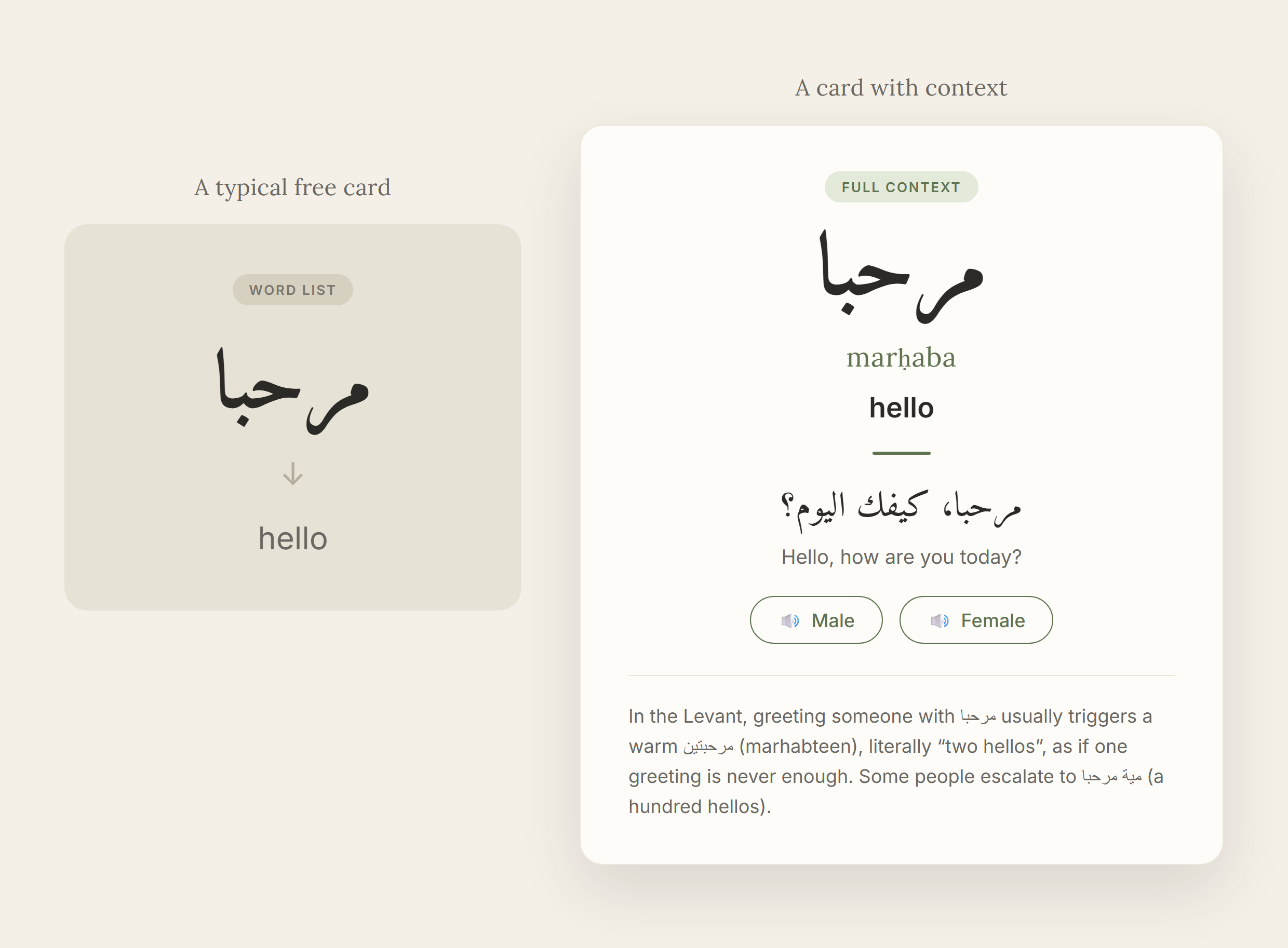
The most important question is whether the words on your cards are things you will genuinely use, and whether they sit next to the other words that naturally surround them in real life. A well-chosen word in the right thematic group beats a beautifully formatted card for a word you will never say.
Once the organisation is right, then card design helps:
- Audio is essential. Hearing a word is how you learn to say it and recognise it when someone says it to you. A card without audio is missing half its job.
- Example sentences help. They give the word a context, which is how meaning actually sticks.
- A clear front and back format matters. You should know exactly what you are being asked and what counts as a correct answer.
- Images matter less. They help if you are a strongly visual learner, but they are not the priority audio and context are.
On consistency, and the deadline problem
This is my own weak point. I have broken many streaks. So many streaks.
Motivation and habit are personal. What keeps one person going does nothing for another. For me, the only thing that reliably worked was having a real deadline pressing on me. An exam, a date, a reason I could not push past. When I learn for a language with no deadline at all, I have to be much more deliberate about protecting the habit, because nothing external is forcing it.
So be realistic about what drives you. If deadlines work for you, create one. If something else works, build around that. Just do not assume motivation will show up on its own every day, because it will not.
Where pre-made decks fit, honestly
I will not pretend otherwise: building your own good language cards is painful. I did it. Reading the books, finding each word, checking how it sounds, formatting the card. It works, and it is genuinely impractical for most people who just want to learn the language rather than become deck builders.
That is the real case for using a well-made deck instead. Not because making your own is wrong, but because the time it costs is time not spent actually using the language. A good deck does the organising for you, gives you the words in a sensible order, with real audio and context, so that all you have to do is the part that matters: showing up every day and, eventually, talking to people.
If that is the trade you want to make, our Arabic and language decks are built around exactly the principles in this article: real spoken vocabulary, professional audio, example sentences, and a sane order so your review count is far less likely to spiral. You can preview a free sample first. If you would rather build your own, that is a respectable path too. Either way, the rules are the same. Start small. Stay consistent. Treat Anki as the support, not the whole plan. And remember that the word only truly becomes yours when you say it to another person.
Frequently asked questions
How many Anki cards should I do per day for language learning?
Start much smaller than you think you need to. Ten or fifteen new cards a day feels like nothing on day one. But Anki is not just new cards. Every card you add comes back for review, so after ten days of fifteen new cards you have a hundred and fifty in rotation, with a growing share coming due each day on top of the new ones. The volume builds quietly. Pick a new-card number you can sustain on a bad day, not a good one.
Is Anki good for language learning?
Yes, but only as one tool among several. Anki is excellent at one job: making vocabulary and phrases stick in your memory over time. It does not teach you grammar in depth, it does not practise conversation, and it does not build listening comprehension at natural speed. Use it to hold your vocabulary while the rest of your learning, talking to people, listening, watching, does the real work.
Why do I keep falling behind on my Anki reviews?
Almost always because you added too many new cards too fast. The pattern is predictable. You feel motivated, you add lots of cards, the review count climbs, you miss one day, and suddenly you are staring at three or four hundred reviews. Then you start to dread opening the app. The tool is not the problem. The fix is to cut your new cards back to a number you can do every single day without thinking about it.
Should I change the default Anki settings?
Eventually, yes. The defaults are a starting point, not a finished setup. Certain settings will suit how your memory works much better once you find them. But do not expect to get this right in week one. Give yourself time to notice how your reviews feel, then adjust. Most people quit before they ever reach this stage.
Can you learn a language with Anki alone?
No. Nobody learns a language from a single tool, and Anki is no exception. Even with a tutor and classes, most of your progress comes from talking with people, making your own notes, and listening to real audio. Anki is a support tool. It makes everything else stick. It does not replace everything else.
Is Anki better for studying medicine than for languages?
It is easier to start with for medicine, mostly because the popular medical decks are genuinely good and the popular beginner language decks are not. There is also a deeper difference. In medicine you usually understand a concept first and then use Anki to retain it. In language learning, vocabulary often goes the other way. You memorise a word first, and you only truly understand it later, once you have used it in a real conversation.
What makes a good Anki card for language learning?
Before card design comes organisation. The words on your cards should be ones you will actually use, grouped with the words that naturally surround them. After that, audio matters most, because hearing a word is how you learn to say it and recognise it. Example sentences help by giving the word context. A clear front and back format matters. Images matter less, unless you are a strongly visual learner.